2027 editionAnswerOps Annual Intelligence Series 2027

Best AI Visibility Platforms in 2027

Compare the platforms helping brands understand where they appear in AI-generated answers, which competitors are recommended, which sources are cited and what actions can improve discovery.

Research published . Read from vendor pages. No hands-on testing.

Compare the platformsHow we researched it

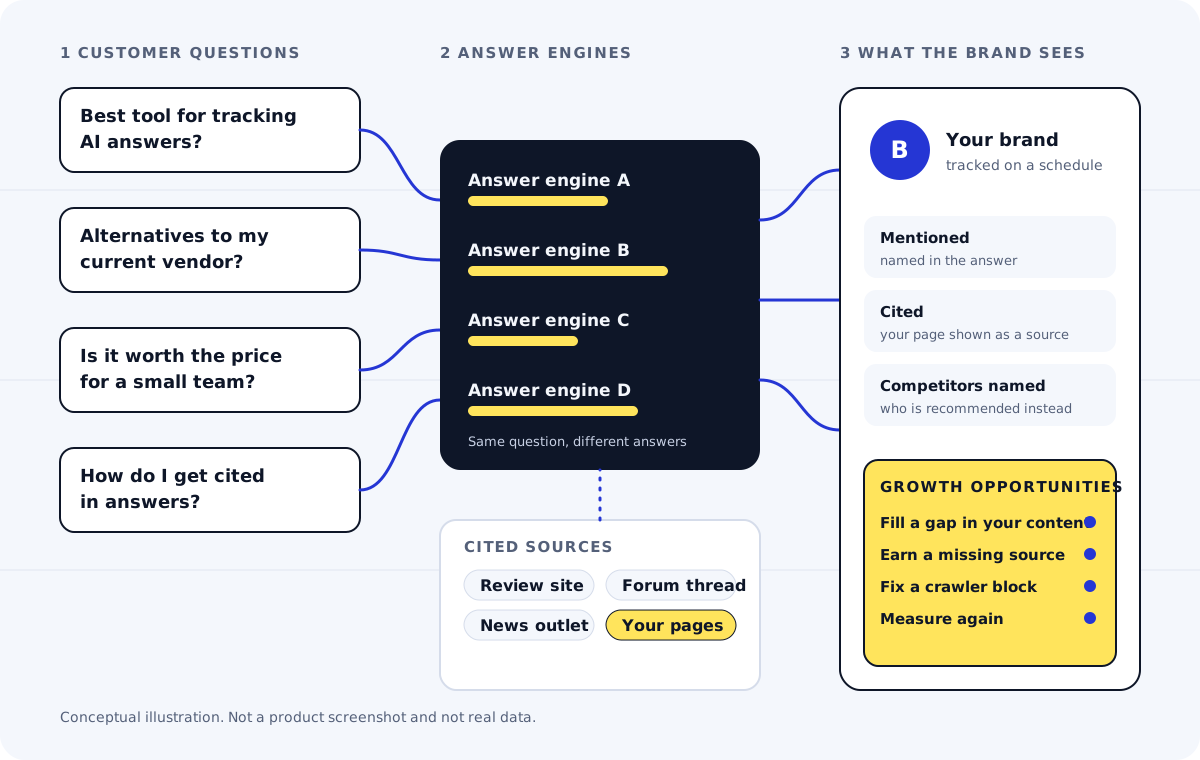
Diagram: customer questions are asked of several answer engines, which draw on cited sources and name competitors. The brand sees whether it was mentioned or cited, and growth opportunities follow from the gaps.
How a brand shows up in AI answers. A conceptual illustration, not a product screenshot.

The short answer

  • An AI visibility platform tracks whether your brand is mentioned, cited and recommended in AI answers.
  • No single platform is best for everyone. This guide covers 7: Peec AI, OtterlyAI, Profound, AthenaHQ, Scrunch, Rankscale, Semrush AI Visibility.
  • OtterlyAI has the lowest published entry price ($29 a month). Profound publishes no self-serve price. The rest sit between $95 and $295.
  • Check four things: coverage, economics, evidence and action. Then trial your shortlist on your own prompts.

Best by use case

Which platform for which job

Picks come from published plan data. Where the evidence does not separate platforms, the guide says so instead of naming a winner.

Matrix of platforms named for each use case

Which platforms the guide points to for each use case. A mark means the platform is named for that use case, not a score.
Use casePeec AIOtterlyAIProfoundAthenaHQScrunchRankscaleSemrush
small businesses–––––
enterprise teams––––
agencies––––
broad engine coverage––––
source and citation analysis––––––
competitor intelligence–––––
connecting insights to content work–––––
  • Best for small businesses

    OtterlyAI, then Peec AI

    OtterlyAI has the lowest published entry price ($29) and lets you pick engines. Peec AI costs more but gives 50 daily prompts on three models with unlimited competitors.

    Keep in mind: Otterly Lite allows 16 to 20 prompts. A business with many products or locations will outgrow it quickly.

    OtterlyAIPeec AI

  • Best for enterprise teams

    A shortlist: Profound, Peec AI Enterprise, Scrunch Enterprise

    All three publish SSO and broad engine coverage on a custom plan (up to 10, 26 and 9 engines). Published information does not separate them. Choose after a trial on your own prompts.

    Keep in mind: Profound and the Enterprise tiers publish no price. Compare quotes, not pages.

    ProfoundPeec AIScrunch

  • Best for agencies

    Rankscale Growth, with OtterlyAI and Peec AI worth a look

    Rankscale is the only vendor here that publishes white-label dashboard links on a priced plan ($385). OtterlyAI sets engines per client workspace. Peec AI and Scrunch have agency pricing pages that were not read.

    Keep in mind: Rankscale pricing is credit-based. Estimate each client's prompts before you quote work.

    RankscaleOtterlyAIPeec AI

  • Best for broad engine coverage

    No single winner

    Rankscale lists 17 or more engines, Peec AI Enterprise up to 26 models, and AthenaHQ Starter 11 named models at a published price.

    Keep in mind: More engines is not better by itself. Each added engine can use more credits or prompts.

    RankscalePeec AIAthenaHQ

  • Best for source and citation analysis

    Peec AI

    Peec AI publishes the most detail here: citation share, domain and URL views, source classification and gap analysis on every plan.

    Keep in mind: Published feature lists show what exists, not how accurate it is. Test with prompts you already know the answers to.

    Peec AI

  • Best for competitor intelligence

    Peec AI and AthenaHQ

    Both publish unlimited competitor tracking at their paid self-serve tiers. Scrunch Core limits this to five.

    Keep in mind: Semrush may suit you better if competitor SEO data matters as much as AI answers.

    Peec AIAthenaHQ

  • Best for connecting insights to content work

    Not enough evidence for one pick

    AthenaHQ publishes a content optimisation agent and on-page and off-page actions. Peec AI publishes ranked recommended actions and an agent. Neither page shows results.

    Keep in mind: Recommendations are a vendor feature, not proof that visibility will improve.

    AthenaHQPeec AI

Compare

Sixteen criteria, side by side

Every cell comes from the vendor's own pages, with a source link. Blank cells say the pages did not state it.

Entry price for each tracked prompt (published numbers, simple division)Different engines, frequencies and extras sit behind each figure, so this is a rough guide, not a ranking. Vendors that price in credits or do not publish a price are not shown.
  • OtterlyAI Lite, $29 a month$1.45 per prompt
    20 prompts on 3 engines, daily
  • Peec AI Starter, $95 a month$1.90 per prompt
    50 prompts on 3 models, daily
  • Scrunch Core, $250 a month$2.00 per prompt
    125 prompts on 4 engines, 5,000 responses a month
  • Semrush AI Visibility Starter, $199 a month$3.98 per prompt
    50 daily prompts, includes the Semrush SEO suite
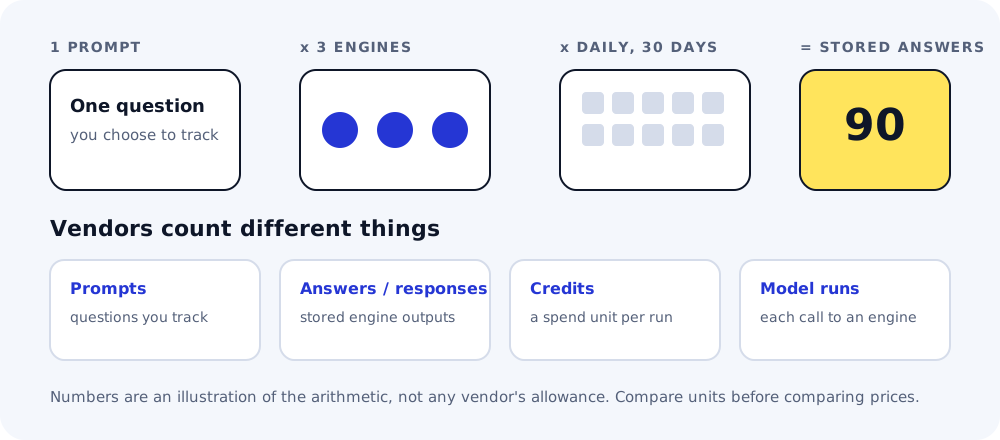
One tracked prompt on three engines, tracked daily for thirty days, creates ninety stored answers. Vendors count prompts, answers, credits or responses, which are different units.
Prompts, answers, credits and responses are not interchangeable. The numbers are an arithmetic illustration, not a vendor allowance.
Seven AI visibility platforms compared on sixteen criteria, from vendor pages read on 14 November 2026. Scroll sideways on small screens.
CriterionPeec AIOtterlyAIProfoundAthenaHQScrunchRankscaleSemrush AI Visibility
Answer enginesEngines the vendor names on its own pages.
Choose 3 of 8 on self-serve: ChatGPT, Perplexity, AI Overview, AI Mode, Gemini, Naver AI Briefing, ERNIE, Bing AI Mode. Enterprise: up to 26 models.Source (opens the vendor page)
Choose at least 3 of 7: ChatGPT, Google AI Overviews, AI Mode, Gemini, Perplexity, Copilot, Claude. Grok, DeepSeek, Qwen and Naver AI are announced as coming.Source (opens the vendor page)
Trial: ChatGPT, Gemini, Google AI Overviews. Enterprise: up to 10, not named on the pricing page.Source (opens the vendor page)
Essential: 5. Starter: 11, including Claude, Grok, DeepSeek, Meta AI and Mistral.Source (opens the vendor page)
Core: 4 (ChatGPT, Perplexity, Google AIO, Copilot). Enterprise: 9, adding Claude, Gemini, Meta AI, AI Mode and Grok.Source (opens the vendor page)
17 or more engines, with API-based and interface-based options.Source (opens the vendor page)
Not itemised on the pages read. The features page names ChatGPT and AI Overviews.
Prompt trackingA prompt is one question you track. Allowances are not equivalent across vendors.
50, 150 or 350 prompts. Unlimited on Enterprise.Source (opens the vendor page)
Lite 16 to 20, Standard 120 to 160, Premium 400 to 535, depending on 3 or 4 engines.Source (opens the vendor page)
Trial: 50 prompts. Enterprise: a tailored prompt plan.Source (opens the vendor page)
Unlimited topics and prompts on Starter, limited in practice by credits.Source (opens the vendor page)
125 unique prompts on Core. Custom on Enterprise.Source (opens the vendor page)
Unlimited search terms. Running them uses credits.Source (opens the vendor page)
50 daily prompts on Starter, 100 on Pro+, unlimited on Advanced.Source (opens the vendor page)
Tracking frequency
Daily. Enterprise: daily or weekly.Source (opens the vendor page)
Daily by default. Weekly option on Premium and Enterprise.Source (opens the vendor page)
Trial: daily for 7 days.Source (opens the vendor page)
Not stated on the pages read
Daily prompt tracking.Source (opens the vendor page)
Brand mentions
Visibility, position, sentiment and share of voice.Source (opens the vendor page)
Tracks when a brand is mentioned and when it is not.Source (opens the vendor page)
Answer Engine Insights for a brand and competitors.Source (opens the vendor page)
Prompt and response analysis, plus brand sentiment.Source (opens the vendor page)
Monitoring and sentiment analysis on Core.Source (opens the vendor page)
Visibility performance tracking and sentiment.Source (opens the vendor page)
Visibility overview and brand performance.Source (opens the vendor page)
Citation analysis
Citation share, domain and URL detail, source classification.Source (opens the vendor page)
Tracks link citations as well as mentions.Source (opens the vendor page)
Not itemised on the pricing page.
Sources insights on the free plan. Citation intelligence on Starter.Source (opens the vendor page)
Citations and sources on Core.Source (opens the vendor page)
Citations analysis and sources box analysis.Source (opens the vendor page)
AI-cited media: outlets that models cite.Source (opens the vendor page)
Source discoveryFinding which pages and outlets the engines rely on.
Gap analysis lists sources that name competitors but not you.Source (opens the vendor page)
Points to the sources engines trust, such as earned media and Reddit.Source (opens the vendor page)
Not itemised on the pricing page.
Citation intelligence, and off-page actions.Source (opens the vendor page)
Citations and sources. Query fan-out is limited on Core.Source (opens the vendor page)
Query fan-out and sources analysis.Source (opens the vendor page)
Prompt research shows prompts that trigger mentions and citations.Source (opens the vendor page)
Competitor tracking
Unlimited competitors on every plan.Source (opens the vendor page)
Shows how a brand compares with competitors. Limits not stated.Source (opens the vendor page)
Competitors appear in Answer Engine Insights.Source (opens the vendor page)
Unlimited competitors on Starter.Source (opens the vendor page)
5 competitors on Core.Source (opens the vendor page)
Competitor benchmarking included.Source (opens the vendor page)
Competitor research and benchmarking.Source (opens the vendor page)
Geographic coverage
1, 3 or 3 countries, unlimited on Enterprise. Unlimited languages.Source (opens the vendor page)
Not stated on the pages read
Trial: 1 region and 1 language.Source (opens the vendor page)
Starter: country-level, one region and language. Enterprise: multiple.Source (opens the vendor page)
Core: 1 country, 1 language, 1 persona.Source (opens the vendor page)
All regions on every plan.Source (opens the vendor page)
Tracks visibility by region. Country limits not itemised.Source (opens the vendor page)
Content recommendations
Recommended actions, split into earned and owned, plus agent actions.Source (opens the vendor page)
On-page GEO recommendations and a content audit.Source (opens the vendor page)
Suggestions (limited on trial) and reusable agents.Source (opens the vendor page)
Content optimisation agent and on-page and off-page actions.Source (opens the vendor page)
Insights and recommendations. 1 page optimisation a month on Core.Source (opens the vendor page)
Rankscale Scout recommendations.Source (opens the vendor page)
Prompt research to find topics. Content optimisation sits in the SEO tools.Source (opens the vendor page)
Site audits
Crawlability audit across 40+ AI bots, from robots.txt rules.Source (opens the vendor page)
Page audit for crawlability, AI-readiness and citation potential.Source (opens the vendor page)
Agent analytics for AI traffic. Audits not itemised.Source (opens the vendor page)
Manages crawler access with robots.txt and llms.txt.Source (opens the vendor page)
5 site audits a month on Core.Source (opens the vendor page)
50 page audits a month on Pro.Source (opens the vendor page)
AI-ready Site Audit and an AI search health audit.Source (opens the vendor page)
Reporting
Shareable dashboards and CSV on all plans. Looker Studio from Advanced.Source (opens the vendor page)
Not stated on the pages read
No exports on the trial.Source (opens the vendor page)
CSV export on Starter. Executive dashboards and BI tools on Enterprise.Source (opens the vendor page)
Reporting dashboard on Core. Looker Studio on Enterprise.Source (opens the vendor page)
Shareable links, CSV, Sheets and Data Studio. White-label from Growth.Source (opens the vendor page)
Report add-ons: Base $10 a month, Pro $20 with white-labelling.Source (opens the vendor page)
API access
Not on Starter. Included from Pro.Source (opens the vendor page)
Not stated on the pages read
A paid add-on on Starter, price unpublished. Included on Enterprise.Source (opens the vendor page)
Advanced data integration on the custom Advanced plan.Source (opens the vendor page)
Agency capabilities
A separate agency pricing page exists. Not read for this guide.Source (opens the vendor page)
An Agency Partner Program, and engines set per client workspace.Source (opens the vendor page)
The pricing page has a separate agencies view. Not read.Source (opens the vendor page)
Enterprise is positioned for enterprises and agencies.Source (opens the vendor page)
An agencies page and agency pricing view exist. Not read.Source (opens the vendor page)
Growth plan adds white-label links and agency benefits.Source (opens the vendor page)
White-label reports through add-ons. Agencies named in plan descriptions.Source (opens the vendor page)
Integrations
Google Analytics, Looker Studio, MCP, and CDN or log providers including Cloudflare, Vercel, WordPress.Source (opens the vendor page)
Not stated on the pages read
Cloudflare, AWS, Fastly, Akamai, Vercel, Netlify, WordPress, Google Analytics.Source (opens the vendor page)
Shopify, Webflow, Google Analytics, Search Console.Source (opens the vendor page)
Looker Studio, API and MCP are Enterprise.Source (opens the vendor page)
MCP, Data Studio, CSV and Sheets.Source (opens the vendor page)
MCP access on Starter. Google Analytics and Search Console in reports.Source (opens the vendor page)
Published pricingAs published on the research date. Taxes and add-ons not included.
$95, $245, $495 a month. Enterprise custom.Source (opens the vendor page)
$29, $189, $489 a month. Enterprise custom.Source (opens the vendor page)
Not published. Free trial, then custom Enterprise.Source (opens the vendor page)
Free, then $295 a month. Enterprise custom.Source (opens the vendor page)
$250 a month. Enterprise custom.Source (opens the vendor page)
$99, $229, $385, $780 a month. Custom plan available.Source (opens the vendor page)
$199 and $299 a month with the SEO suite. Advanced custom.Source (opens the vendor page)
Plan limitations
3 models on self-serve. 1 to 5 projects.Source (opens the vendor page)
At least 3 engines. No top-ups on Lite.Source (opens the vendor page)
Trial ends after 7 days. No self-serve plan.Source (opens the vendor page)
Credit-based. API and extra credits cost more.Source (opens the vendor page)
4 engines, 1 country, 5 competitors on Core.Source (opens the vendor page)
Credit-based. Engines cost 0.25 to 2 credits a run.Source (opens the vendor page)
1 domain for AI brand performance on Starter.Source (opens the vendor page)

Platform profiles

Seven platforms, one format

Each profile covers what it does, who it suits, strengths, limits, the published entry price and what to check before buying.

Profile 1 of 7

Peec AI

$95 a month (Starter)

Tracks how a brand appears across answer engines, which sources are cited and which competitors are named, with recommended actions and an in-app agent.

Consider it if
You want daily tracking, deep source and citation views and unlimited competitors on a published self-serve price.
Entry plan, as published
50 prompts, 3 models, daily, 1 project. Pro $245 (150 prompts), Advanced $495 (350 prompts). Enterprise is custom, billed annually.

Strongest capabilities

  • Source analytics: domain and URL detail, citation share and source classification on every plan.
  • Unlimited competitors, languages and team users on all self-serve plans.
  • Crawlability audit across 40+ AI bots, plus AI referral and crawl insights.
  • Enterprise tracks up to 26 models.

Important limitations

  • Self-serve plans track three models you choose, not all of them.
  • API access starts on Pro. The Data Studio connector and multi-country tracking start on Advanced.
  • Objections analysis is not included on Starter.

Verify before you buy

  • Which three models you will pick, and whether they are the ones your buyers use.
  • The cost of any plan beyond Advanced, which is custom.
  • How agent credits are used, since each plan includes a fixed number.

Official site for Peec AI (opens a new tab)Official pricing for Peec AI (opens a new tab)
Profile 2 of 7

OtterlyAI

$29 a month (Lite)

Monitors mentions and citations in AI answers, with prompt research, a content audit and on-page GEO recommendations.

Consider it if
You want the lowest published entry price and want to choose which engines to spend prompts on.
Entry plan, as published
20 prompts on 3 engines or 16 on 4. Standard $189 (160 or 120). Premium $489 (535 or 400). Enterprise is custom.

Strongest capabilities

  • Lowest published self-serve entry price in this guide: $29 a month.
  • You choose at least three engines per workspace, from seven named engines.
  • Prompt credits can be topped up on Standard and Premium without changing plan.
  • Daily or weekly tracking on Premium and Enterprise.

Important limitations

  • The Lite plan allows 16 to 20 prompts, depending on the engines you choose.
  • Top-ups are not available on Lite.
  • The pricing page itself could not be opened in the research browser, so plan figures come from Otterly's own pricing announcement of 10 November 2026.

Verify before you buy

  • The current pricing page and calculator, because the announcement says existing customers migrate during November 2026.
  • Seats, countries and API access, which the pages read do not state.
  • Whether the engines you need are in the seven named ones.

Official site for OtterlyAI (opens a new tab)Official pricing for OtterlyAI (opens a new tab)

Profile 3 of 7

Profound

Custom (Enterprise). Free 7-day trial.

An enterprise platform that tracks answer engines and runs an AI marketing assistant with agents, a context manager and agent analytics.

Consider it if
You are an organisation that will buy through a sales process and needs SSO, SOC 2 and broad engine coverage.
Entry plan, as published
Pricing is quote-based. Third-party sites still list older $99 and $399 plans, which the vendor's pricing page did not show.

Strongest capabilities

  • Enterprise tracks up to ten answer engines.
  • Agent analytics tracks AI-sourced traffic across unlimited domains.
  • Integrations include Cloudflare, AWS, Vercel, Netlify, WordPress and Google Analytics.

Important limitations

  • No published self-serve price. On the research date the pricing page showed a free trial and a custom Enterprise plan only.
  • The trial is 50 prompts daily for 7 days, on three engines, with no exports or API.
  • Enterprise engine names and prompt limits are not listed on the pricing page.

Verify before you buy

  • The price and the credit allowance, which are set in a sales conversation.
  • Exactly which ten engines are covered.
  • Whether the agency offering fits your client model.

Official site for Profound (opens a new tab)Official pricing for Profound (opens a new tab)

Profile 4 of 7

AthenaHQ

$295 a month (Starter). Free Essential plan.

Credit-based tracking across answer engines with content optimisation actions, citation intelligence and an AI agent.

Consider it if
You are a small team that wants broad engine coverage and content actions on a published price, and can manage a credit budget.
Entry plan, as published
Starter includes 3,600 credits and one month of rollover. Annual billing is advertised at 17% off. Enterprise is custom.

Strongest capabilities

  • A free Essential plan with 300 credits on five engines.
  • Starter covers 11 named models with unlimited topics, prompts and competitors.
  • On-page and off-page actions, a content optimisation agent, and smart robots.txt and llms.txt management.
  • Shopify, Webflow, Google Analytics and Search Console integrations are listed.

Important limitations

  • One credit is one AI response, so cost grows with prompts, engines and frequency.
  • API access and extra credits are paid add-ons with unpublished prices.
  • Starter covers a single region and language. Multiple regions and languages are Enterprise.

Verify before you buy

  • How many credits your prompt list will use each month.
  • The price of API access and extra credits.
  • Whether one region and language is enough.

Official site for AthenaHQ (opens a new tab)Official pricing for AthenaHQ (opens a new tab)

Profile 5 of 7

Scrunch

$250 a month (Core). 7-day free trial.

Monitors citations and sources, analyses AI bot traffic and audits sites, with an Agent Experience Platform for Enterprise customers.

Consider it if
You want a published, fixed-limit plan with site audits and bot traffic, or you are an enterprise considering agent-facing pages.
Entry plan, as published
Enterprise is custom. The pricing page has an agencies view that was not read for this guide.

Strongest capabilities

  • Core states its limits plainly: 125 unique prompts and 5,000 responses a month.
  • Site audits, bot traffic and sentiment are included on Core.
  • Enterprise lists nine LLMs and the Agent Experience Platform.

Important limitations

  • Core tracks four engines: ChatGPT, Perplexity, Google AI Overviews and Copilot.
  • Core covers one country, one language, five competitors and one brand workspace.
  • API, Looker Studio, MCP and the Agent Experience Platform are not on Core.

Verify before you buy

  • Whether four engines cover the ones your buyers use.
  • Tracking frequency, which the pricing page does not state.
  • What the Agent Experience Platform costs and requires on your site.

Official site for Scrunch (opens a new tab)Official pricing for Scrunch (opens a new tab)

Profile 6 of 7

Rankscale

$99 a month (Pro). Free Pro trial offered.

Credit-based AI visibility tracking across 17 or more engines, with citations, sentiment, query fan-out, page audits and agency options.

Consider it if
You are an agency or a technical team that wants wide engine choice and flexible scheduling and will plan around credits.
Entry plan, as published
1,200 credits, up to 4,800 answers. Pro+ $229, Growth $385, Enterprise $780, plus a custom plan. Yearly billing saves 15%.

Strongest capabilities

  • 17 or more engines, with hourly to monthly scheduling.
  • Unlimited search terms and all regions on every plan.
  • White-labelled dashboard links on the Growth plan.
  • MCP, Data Studio and CSV or Sheets exports on every plan.

Important limitations

  • Costs depend on credits: engines are priced per run, from 0.25 to 2 credits in the published calculator.
  • REST API access starts on Pro+. White-label links start on Growth.
  • Credit use is hard to predict until you run the calculator on your own prompt list.

Verify before you buy

  • Your own credit estimate, using the calculator on the pricing page.
  • Which engines are API-based and which are interface-based.
  • What the credit rollover limit is.

Official site for Rankscale (opens a new tab)Official pricing for Rankscale (opens a new tab)

Profile 7 of 7

Semrush AI Visibility

$199 a month (Starter, SEO + AI Search)

AI visibility tracking, prompt research, sentiment, competitor research and an AI-ready site audit, inside Semrush's SEO and AI Search plans.

Consider it if
You already use Semrush for SEO and want AI visibility in the same place, with reporting and agency tools.
Entry plan, as published
Billed monthly. Annual billing shows $165.17 a month. Pro+ is $299. Advanced is custom. Extra users start at $45 a month.

Strongest capabilities

  • AI visibility and SEO data in one platform.
  • Prompt research, AI-cited media and competitor research.
  • White-label reporting through paid report add-ons.

Important limitations

  • On the research date the AI visibility tools were sold inside the Starter ($199) and Pro+ ($299) SEO plans, with 50 and 100 daily prompts. A separate $99 toolkit reported by third parties was not on the pricing page read.
  • Starter tracks one domain for AI brand performance.
  • Which engines are covered is not itemised on the pages read.

Verify before you buy

  • Whether a standalone AI visibility plan is still sold and its price.
  • Exactly which engines and countries are covered.
  • Whether you need the full SEO suite you pay for with it.

Official site for Semrush AI Visibility (opens a new tab)Official pricing for Semrush AI Visibility (opens a new tab)

How to evaluate

Coverage, economics, evidence, action

Four questions that tell a useful platform from a long feature list.

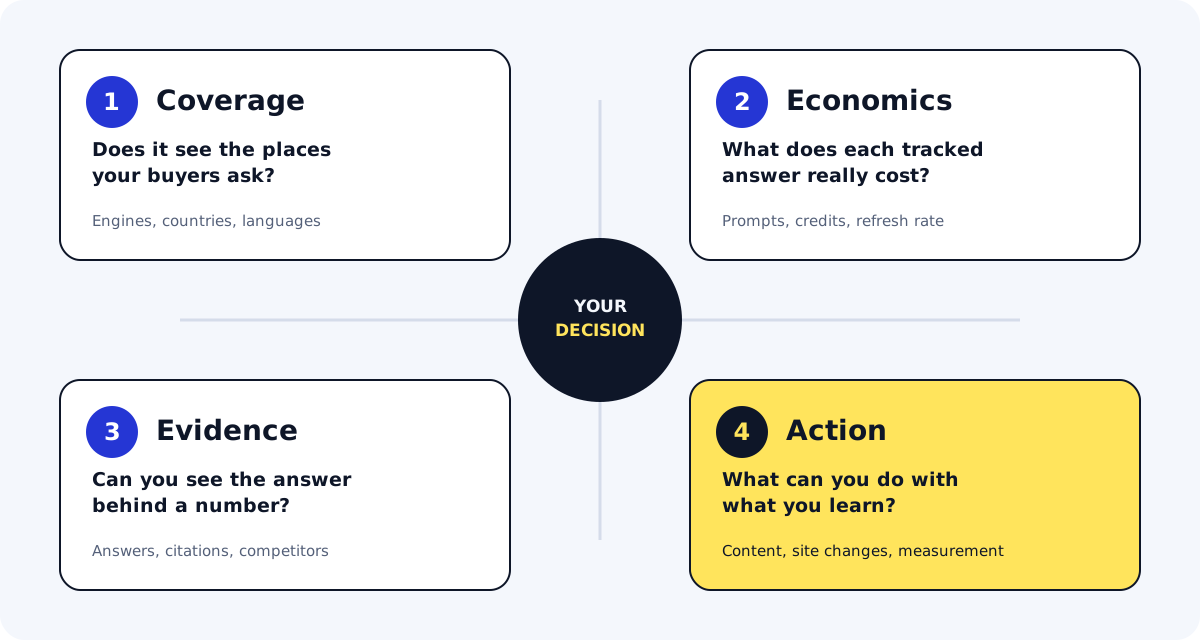
Four dimensions around the buyer's decision: Coverage, Economics, Evidence and Action, each with the one question it answers.
The buyer's evaluation framework. A conceptual diagram.
  1. 1

    Coverage

    Does it see the places your buyers ask?

    • Engines and AI surfaces
    • Countries and languages
    • Personas or segments
  2. 2

    Economics

    What does each tracked answer really cost?

    • Prompts, responses and credits
    • Refresh frequency
    • Add-ons and top-ups
  3. 3

    Evidence

    Can you see the answer behind a number?

    • Original answers
    • Citations and sources
    • Competitor mentions
  4. 4

    Action

    What can you do with what you learn?

    • Content and site recommendations
    • Workflows and integrations
    • Measuring the effect of changes
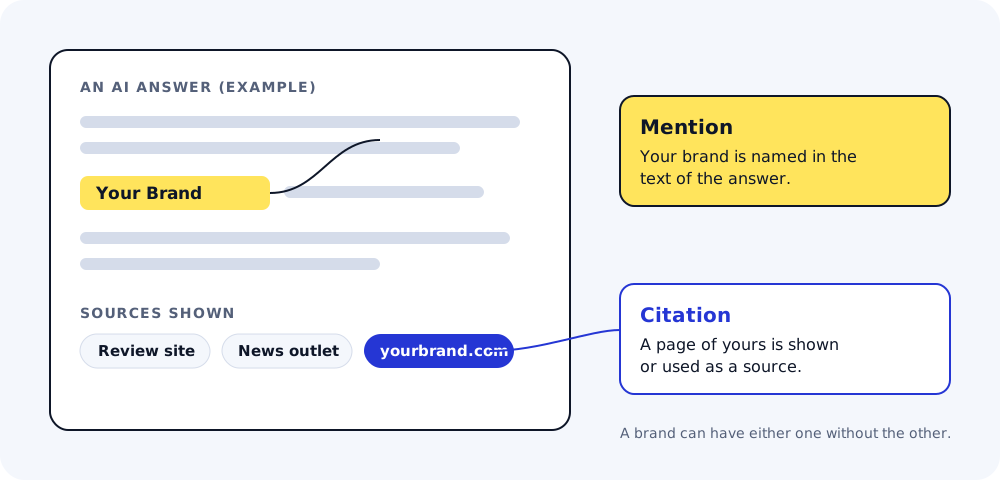
An example AI answer. The brand name inside the text is a mention. A page of the brand shown among the sources is a citation. A brand can have one without the other.
Mentions and citations are different signals.

Two terms people mix up

A mention means the brand is named in the answer. A citation means a page is shown or used as a source. Ask every vendor to show you both, with the original answer, for a prompt you already know the answer to.

Buyer decision guide

Where to start, by team

Practical starting points. Always confirm against the vendor's current pricing page.

  • Small businesses

    Start with: A low-cost plan with a handful of prompts for your category and your top three competitors. Daily tracking matters less than choosing the right questions.

    Watch for: Prompt caps, and whether the plan lets you pick engines.

  • SaaS companies

    Start with: Prompts for comparisons and alternatives, citations from review sites and your own docs, and exports you can send to analytics.

    Watch for: API access, integrations, and which engines your buyers use.

  • Marketing teams

    Start with: Shared dashboards, source analysis and recommended actions the team can assign.

    Watch for: Seats, reporting limits and whether actions connect to your CMS.

  • Agencies

    Start with: Multi-brand workspaces, white-label reports and prompt allowances you can price per client.

    Watch for: Per-workspace limits and how credits are shared.

  • Ecommerce brands

    Start with: Product-level tracking and shopping answers. Peec AI and Rankscale publish shopping features; AthenaHQ lists Shopify integration.

    Watch for: Catalogue limits and whether shopping surfaces are included in your tier.

  • Enterprise organisations

    Start with: Security review, SSO, regional coverage and a trial on your own prompts before a contract.

    Watch for: Custom pricing, data retention and support terms.

Beyond measurement

Measurement is where growth starts

Knowing where you appear is useful. What you do next decides the result.

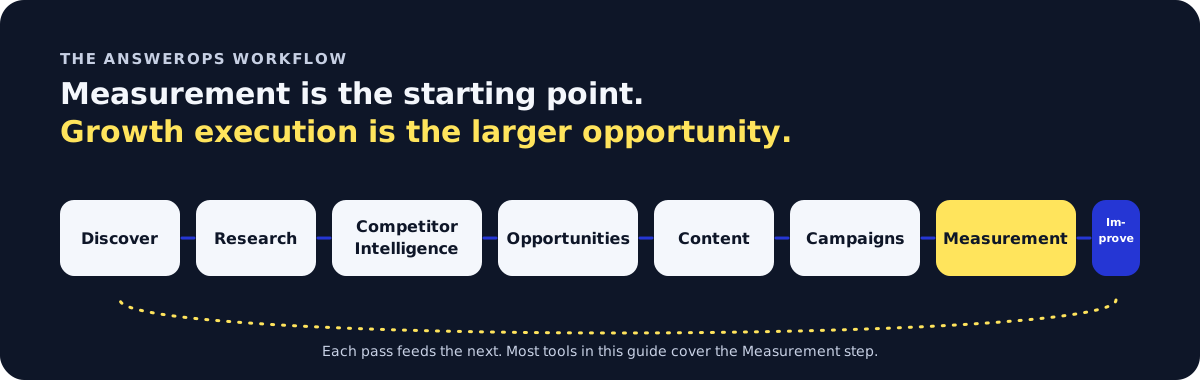
The AnswerOps workflow: Discover, Research, Competitor Intelligence, Opportunities, Content, Campaigns, Measurement, Improvement. Measurement is the starting point and growth execution is the larger opportunity.

Measuring AI visibility is the starting point. Deciding what to change, making the change and checking the result is the larger job. AnswerOps is being built for that whole loop, and it is in early access: the website audit and growth opportunities are available, AI visibility monitoring is in development, and keyword and competitor research and the Content Studio are planned. The home page lists each status.

Run the free Website Readiness CheckSee the free toolsCapability status

Methodology

How this guide was made, and what it cannot tell you

Read this before relying on any figure on this page.

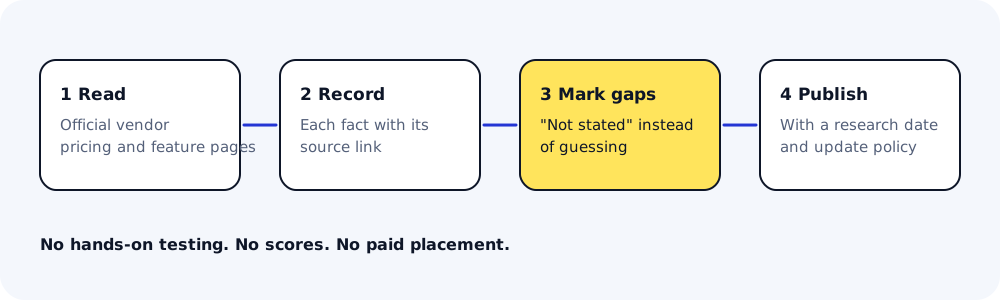
Four steps: read official vendor pages, record each fact with its source, mark gaps as not stated, publish with a research date. No hands-on testing, no scores, no paid placement.
How this guide was researched. A conceptual diagram.
Research date
14 November 2026
Pricing verified
14 November 2026

Evaluation criteria

  • Engines named by the vendor
  • Prompt, response and credit allowances
  • Tracking frequency
  • Citation and source features
  • Competitor, geographic and agency features
  • Reporting, API and integrations
  • Published pricing and plan limits

Tested or read?

No product was tested hands-on. Every vendor fact comes from the vendor's own public pages, read on the research date. Claims on vendor pages, such as customer counts, awards and ratings, are not repeated here.

Limitations

  • Prices and limits change. Check each linked pricing page before buying.
  • Pages differ in detail, so a blank cell means the pages read did not say, not that the feature is missing.
  • Prompts, answers, credits, responses and model runs are different units. Allowances are shown as published and are not converted.
  • The OtterlyAI pricing page could not be opened, so its plan figures come from the vendor's pricing announcement of 10 November 2026 and its home page.
  • Agency pages for Peec AI, Profound and Scrunch were not read.
  • This is a 2027 edition prepared in November 2026. It is not a study of the 2027 calendar year.

Commercial disclosure

AnswerOps publishes this guide and is itself a product in the wider AI visibility space, so it has an interest in the topic. No vendor paid for inclusion, ranking or wording. AnswerOps is not ranked here.

Update policy

The guide is dated and will be reviewed against vendor pages at least once a quarter. Material changes will be noted with a new research date.

FAQ

Questions buyers ask

Short, direct answers.

What is an AI visibility platform?

It is software that asks AI answer engines a set of questions on a schedule and records whether your brand is named, which sources are cited and which competitors appear. Most also suggest actions.

How does AI visibility tracking work?

You choose prompts that match what customers ask. The platform runs them against selected engines, stores each answer and calculates metrics such as mention rate and cited sources. Because answers vary between runs, a single answer is a sample, not a verdict.

Which tools are suitable for small businesses?

On published prices, OtterlyAI ($29 a month) and Peec AI ($95 a month) are the lowest-cost self-serve options in this guide. Check prompt caps against the questions you need to track.

What is the difference between mentions and citations?

A mention is your brand named in an answer. A citation is a source link the engine shows or uses. A brand can be mentioned without its site being cited, and a site can be cited without the brand being recommended.

How many prompts should a business track?

There is no standard number. Start with the questions that decide a purchase in your category, across the engines your buyers use, and add more once you can act on what you already track. Published plans in this guide range from 16 to 535 prompts.

Do these platforms improve visibility automatically?

No vendor page read for this guide says visibility improves by itself. They measure and recommend. Improvement depends on what you change on your site and elsewhere, and results are not guaranteed.

How should AI visibility tools be evaluated?

Use four checks: coverage of the engines and markets you need, the real cost of prompts and refreshes, evidence you can inspect behind each metric, and what you can do with the findings. Run a trial on your own prompts.

Why does this guide not give scores or a single winner?

The research reads published pages only and did not run hands-on tests, so a numerical score would imply testing that did not happen. It groups platforms by use case instead.

Research sources

Official vendor pages used

All read on 14 November 2026. Links open the vendor's own page.